Foxes are very diverse, each species able to survive in environments which include forests, grasslands, mountains, and deserts.They were introduced to Australia in the mid-19th century and are native to North America, Europe, Asia and North Africa.
Despite being a canine species, foxes resemble cats more than dogs. Their pupils are vertical slits, which gives they great night vision. many foxes are also excellent climbers and scale trees and roofs to stalk birds and squirrels. Some even sleep in trees. Foxes even have spine-covered tongues and extremely sensitive whiskers that help maintain balance. Grey foxes even have semi-retractable claws which give them an amazing ability to climb trees. The ability makes it easier to escape from predators or even red foxes if needed.
They can run up to 48km/h, leap 2 meters high, and have about 28 different vocalizations. This canid is rather unique and has even been found buried with men which where older than the oldest dog burial site found.
Food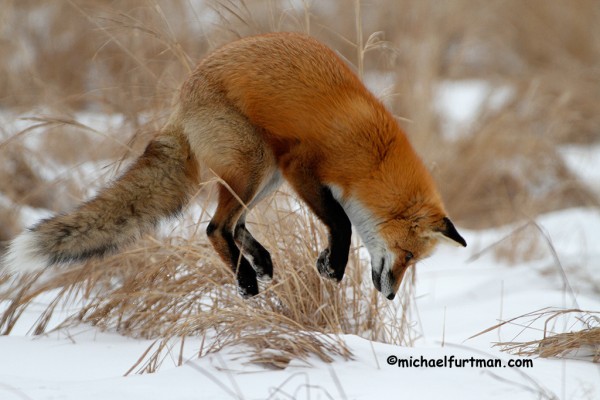
Foxes are omnivores and appreciate the occasional rodent, or bird. They specialize in a variety of small prey and have a number of different hunting techniques for different animals. Insects form a large part of the foxes diet, but they are just casually foraged and snapped at while they happen to come by. Bigger prey such as rabbits are approached with stalking. The fox lies flat on the ground and silently creeps towards the prey, until a short chase ensues. If the object of stalking is a bird, the fox finishes the chase with a massive leap that often catches the prey midair.The most famous hunting technique in the arsenal of the fox is probably the mousing leap.A fox moves slowly and silently, listening intently until it detects the sound of a mouse. Then, it suddenly launches in the air, landing directly on its unlucky target. Foxes are so good at this missile-like maneuver that they can even locate and catch their prey when it moves under more than a meter of snow.Foxes are great night-time predators because their eyes are specially adapted to night vision. Behind the light sensitive cells lies another layer called the tapetum lucidum which reflects light back through the eye. This doubles the intensity of images received by the fox. Their eyes glow green when light is shone into them at night.
General Characteristics
(Mostly based on Red foxes)

Build 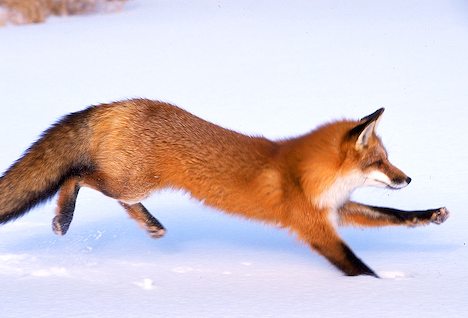
The red fox has an elongated body and relatively short limbs. The tail is longer than half the body length ( about 70% of head and body length,bushy tail that reaches the ground. Their pupils are oval and vertically oriented. Nictitating membranes are present, but move only when the eyes are closed. The fore-paws have five digits, while the hind feet have only four and lack dewclaws. They are very agile, being capable of jumping over 2-meters (6 ft 7 in) high fences, and swim well. Vixens normally have three pairs of teats, though vixens with seven, nine or ten teats are not uncommon.
Their skulls are fairly narrow and elongated, with small brain cases. Their canine teeth are relatively long. Sexual dimorphism of the skull is more pronounced than in corsac foxes, with female red foxes tending to have smaller skulls than males, with wider nasal regions and hard palates, as well as having larger canines. Their skulls are distinguished from those of dogs by their narrower muzzles, less crowded premolars, more slender canine teeth and their concave rather than convex profiles.
Dimensions
Red foxes are the largest species of fox. Their scientific name is fairly simple- Vulpes vulpes. However, relative to dimensions, red foxes are much lighter than similarly sized dogs of the genus Canis. Their limb bones weigh 30% less per unit area of bone than expected for similarly sized dogs. They display significant individual, sexual, age and geographical variation in size. On average, adults measure 14–20 inches high at the shoulder and 18 to 35 inches in body length with tails measuring 13 to 21 inches. The ears measure 3–5 inches and the hind feet 5–7 inches. They weigh 4.9 to 30.9 lb, with vixens typically weighing 15–20% less than males. Adult red foxes have skulls measuring 5.1–6.6 inches, while those of vixens measure 5.0–6.3 inches. The forefoot print measures 2.4 inches in length and 1.8 inches in width, while the hind foot print measures 2.2 inches long and 1.5 inches wide. They trot at a speed of 6–13 km/h, and have a maximum running speed of 50 km/h. They have a stride of 9.8–13.8 inches when walking at a normal pace. North American red foxes are generally lightly built, with comparatively long bodies for their mass and have a high degree of sexual dimorphism. British red foxes are heavily built, but short, while continental European red foxes are closer to the general average among red fox populations.
Fur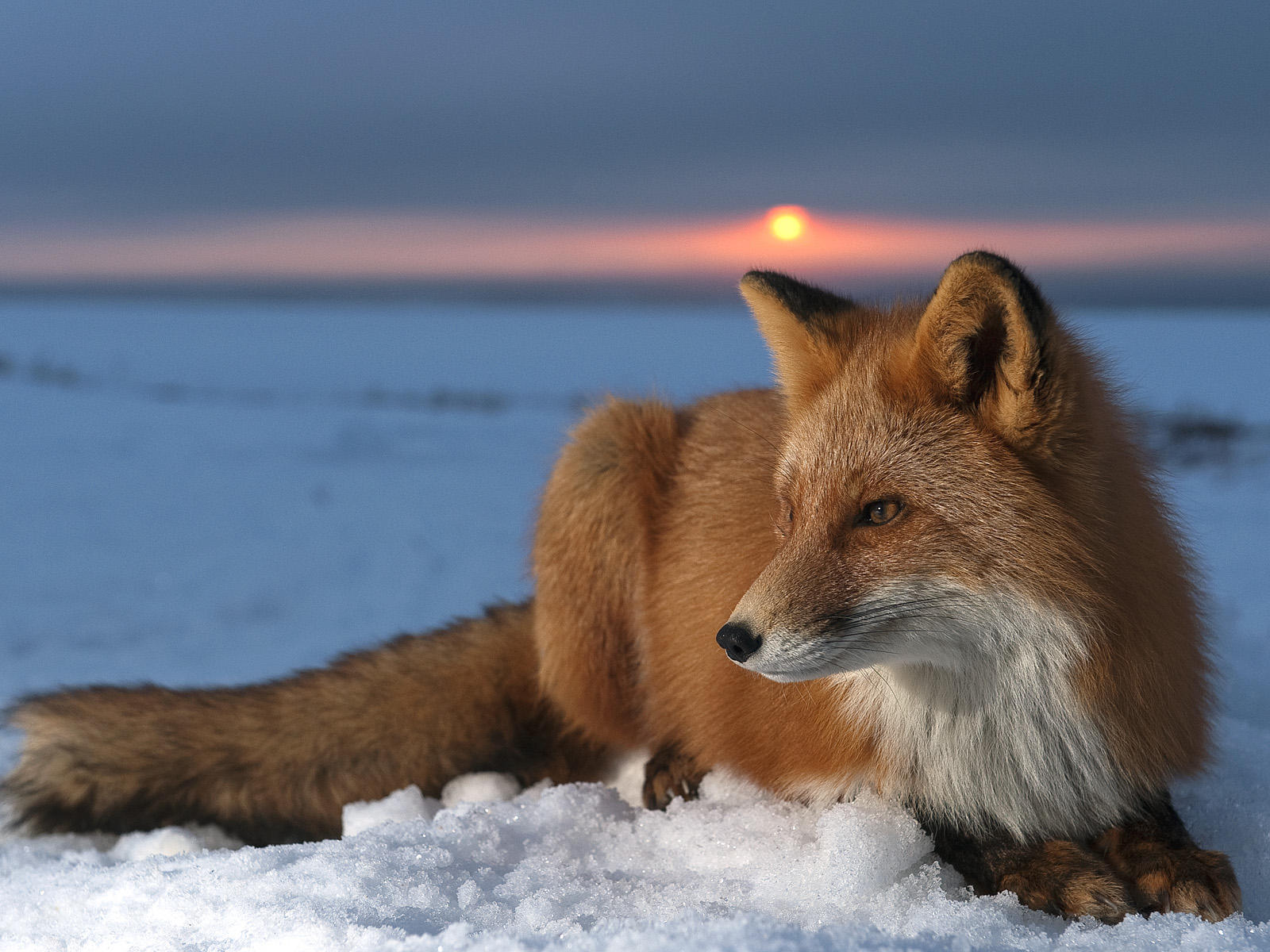
The winter fur is dense, soft, silky and relatively long. For the northern foxes, the fur is very long, dense and fluffy, but is shorter, sparser and coarser in southern forms. Among northern foxes, the North American varieties generally have the silkiest guard hairs, while most Eurasian red foxes have coarser fur. There are three main color morphs; red, silver/black and cross. In the typical red morph, their coats are generally bright reddish-rusty with yellowish tints. A stripe of weak, diffuse patterns of many brown-reddish-chestnut hairs occurs along the spine. Two additional stripes pass down the shoulder blades which, together with the spinal stripe, form a cross. The lower back is often a mottled silvery color. The flanks are lighter colored than the back, while the chin, lower lips, throat and front of the chest are white. The remaining lower surface of the body is dark, brown or reddish. During lactation, the belly fur of vixens may turn brick red. The upper parts of the limbs are rusty reddish, while the paws are black. The frontal part of the face and upper neck is bright brownish-rusty red, while the upper lips are white. The backs of the ears are black or brownish-reddish, while the inner surface is whitish. The top of the tail is brownish-reddish, but lighter in color than the back and flanks. The underside of the tail is pale grey with a straw-colored tint. A black spot, the location of the supracaudal gland, is usually present at the base of the tail. The tip of the tail is white.
Social and territorial behavior
Red foxes either establish stable home ranges within particular areas or are itinerant with no fixed abode. They use their urine to mark their territories. A male fox raises one hind leg and his urine is sprayed forward in front of him, whereas a female fox squats down so that the urine is sprayed in the ground between the hind legs. Urine is also used to mark empty cache sites, used to store found food, as reminders not to waste time investigating them. The use of up to 12 different urination postures allows them to control the position of the scent mark. Red foxes live in family groups sharing a joint territory. In favorable habitats and/or areas with low hunting pressure, subordinate foxes may be present in a range. Subordinate foxes may number 1 or 2, sometimes up to 8 in one territory. These subordinates could be formerly dominant animals, but are mostly young from the previous year, who act as helpers in rearing the breeding vixen's kits. Alternatively, their presence has been explained as being in response to temporary surpluses of food unrelated to assisting reproductive success. Non-breeding vixens will guard, play, groom, provision and retrieve kits, an example of kin selection. Red foxes may leave their families once they reach adulthood if the chances of winning a territory of their own are high. If not, they will stay with their parents, at the cost of postponing their own reproduction.
Most of the information on this page can be found here and here.
Videos and other info can be found here.